
Keywords
Statistical software
Data analysis
Open science
Applied statistics
How to Cite


Abstract
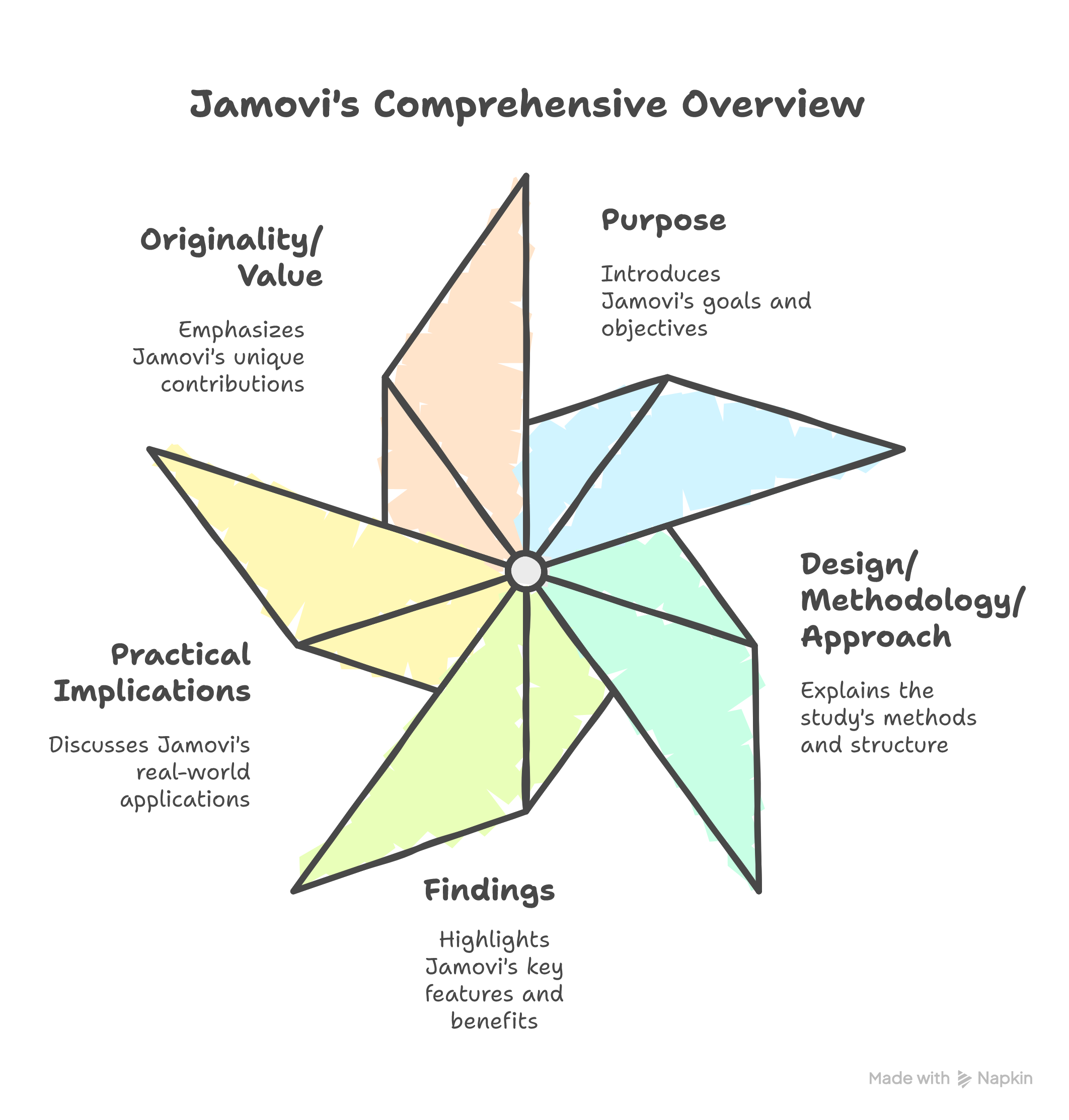
Purpose: This article aims to introduce Jamovi, a free and open-source statistical analysis software based on the R language, highlighting its functionalities, accessibility, and potential applications in academic and professional environments.
Design/Methodology/Approach: The study adopts a descriptive and applied approach, presenting a comparative review of Jamovi's core features in relation to traditional software such as SPSS and SAS. It also includes a practical tutorial demonstrating data import, execution of statistical tests, and interpretation of results using Jamovi’s graphical interface.
Findings: Jamovi stands out for its intuitive usability, cross-platform compatibility, and seamless integration with R. Its modular structure and real-time feedback facilitate both basic and advanced analyses without requiring extensive programming knowledge. The active developer community ensures frequent updates and a growing repository of analytical modules.
Practical Implications: Jamovi offers a cost-effective and pedagogically efficient tool for researchers, instructors, and students. It contributes to reducing financial and technical barriers in statistical education and promotes statistical literacy.
Originality/Value: The article highlights the relevance of Jamovi as an inclusive and adaptable platform for quantitative research, especially in contexts demanding accessible and open-source solutions.
References
Ahmed, A. A., & Muhammad, R. A. (2021). A Beginners review of Jamovi statistical software for economic research. Dutse International Journal of Social and Economic Research, 6(1), 109-118.
Bartlett, J. E., & Charles, S. J. (2022). Power to the People: A Beginner’s Tutorial to Power Analysis using Jamovi. Meta-Psychology, 6.
Caldwell, A. R. (2022). SimplyAgree: an R package and Jamovi module for simplifying agreement and reliability analyses. Journal of Open Source Software, 7(71), 4148.
Hair, J. F., Black, W. C., Babin, B. J., Anderson, R. E. (2019). Multivariate data analysis. (8th ed.). Hampshire, UK: Cengage Learning, EMEA.
Kangiwa, B. I., Ladan, I. M., Nassarawa, H. S., Sabo, S. A., & Umar, M. A. (2024) Free and Open-Source Software for Data Analysis: Leveraging the Potentials of JASP, Jamovi and PSPP in Nigeria Tertiary Institutions. International Journal of Multidisciplinary Research in Science, Technology and Innovation, 3 (1), 1-8.
Leppink, J. (2022). Data analysis: more expensive does not imply better. Revista Española de Educación Médica, 3(2).
Navarro, D. J., & Foxcroft, D. R. (2019). Learning statistics with Jamovi: A tutorial for psychology students and other beginners (Version 0.70). Tillgänglig online: http://learnstatswithJamovi. com [Hämtad 14 december].
Richardson, P., & Machan, L. (2021). Jamovi for Psychologists. Bloomsbury Publishing.
Şahin, M., & Aybek, E. (2019). Jamovi: an easy-to-use statistical software for the social scientists. International Journal of Assessment Tools in Education, 6(4), 670-692.
Stevens, S. S. (1946). On the theory of scales of measurement. Science, 103(2684), 677-680.