
Keywords
Governance Institutes
IBGC
IPCG
Institutional Theory
How to Cite


Abstract
Objective: This study investigates the role of corporate governance (CG) institutes in Brazil and Portugal in developing and promoting good governance practices. Specifically, it seeks to understand how the institutional configurations of the Brazilian Institute of Corporate Governance (IBGC) and the Portuguese Institute of Corporate Governance (IPCG) differ, and how these differences influence the adoption of governance practices.
Methodology: A qualitative, descriptive case study approach was employed, combining in-depth interviews, document analysis, and direct observation. Key actors, including founders and board members, were interviewed, and official documents were analyzed using content analysis with NVivo software, focusing on institutional and educational categories.
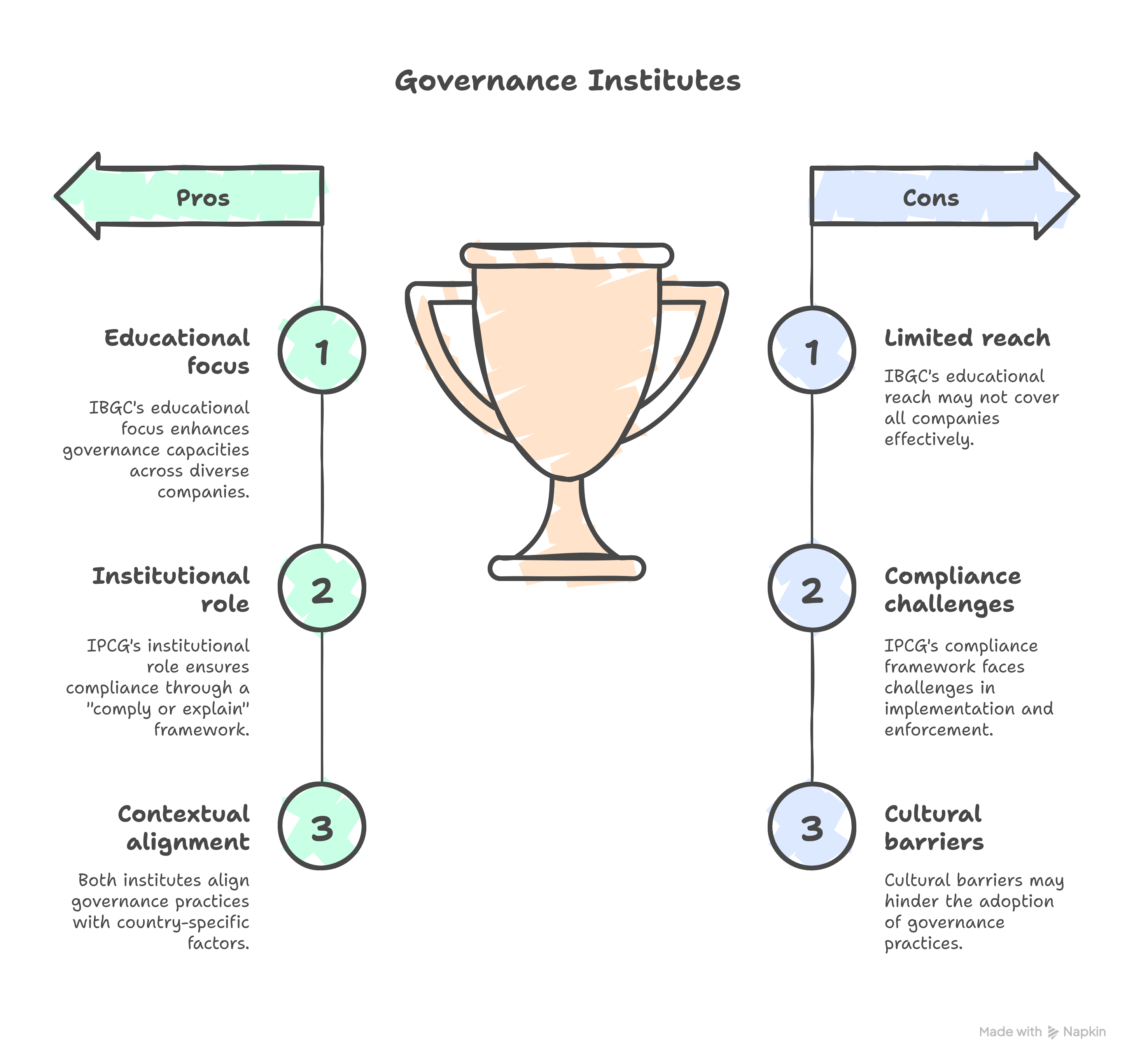
Results: Findings reveal that the IBGC emphasizes educational activities, offering extensive training and publications to enhance the governance capacities of diverse companies, from small family-owned businesses to large listed corporations. In contrast, the IPCG plays a more institutional role, developing the national governance code and overseeing its implementation among listed companies under a “comply or explain” framework. While both institutes contribute to enhancing corporate governance, their approaches are shaped by country-specific institutional, economic, and cultural factors.
Theoretical Contribution: This study reinforces the relevance of institutional theory by demonstrating how governance practices are shaped by local contexts. It also enriches the understanding of how governance institutes influence corporate behavior beyond merely drafting codes, by acting as educators or institutional enforcers.
Practical Implications: Managers, investors, and policymakers can use these insights to better align governance practices with local realities and to design strategies for improving governance effectiveness and trust in different markets.
References
Aguilera, R. V., & Desender, K. (2012). Methodological challenges in comparative corporate governance and strategic issues. Research methodology in strategy and management. Bingley (UK): Emerald Group Publishing Limited.
Andrade, A., & Rossetti, J. P. (2014). Governança Corporativa: fundamentos, desenvolvimento e tendências. São Paulo: Atlas.
Basu, A. K., Lal, R., Srinivasan, V., & Staelin, R. (1985). Salesforce compensation plans: An agency theoretic perspective. Marketing science, 4(4), 267-291. https://doi.org/10.1287/mksc.4.4.267
Berle, A., & Means, G. (1932). The modern corporation and private property (mac-millan, new york, ny).
Braga‐Alves, M. V., & Shastri, K. (2011). Corporate governance, valuation, and performance: evidence from a voluntary market reform in Brazil. Financial Management, 40(1), 139-157. https://doi.org/10.1111/j.1755-053X.2010.01137.x
Code, C. (1992). The financial aspects of corporate governance. London: The Committee on the Financial Aspects of Corporate Governance and Gee and Co. Ltd, 1(3).
Chen, J. (2019). Securities and Exchange Commission (SEC). Investopedia. Recuperado de https://www.investopedia.com/terms/s/sec.asp.
Coase, R. H. (1937). The Nature of the Firm. Economica, 4(16), 386-405.
Crisóstomo, V. L., & Girão, A. M. C. (2019). Análise do compliance das empresas brasileiras às boas práticas de governança corporativa. REVISTA AMBIENTE CONTÁBIL-Universidade Federal do Rio Grande do Norte-ISSN 2176-9036, 11(2), 40-64. https://doi.org/10.21680/2176-9036.2019v11n2ID16369
Cuomo, F., Mallin, C., & Zattoni, A. (2016). Corporate governance codes: A review and research agenda. Corporate governance: an international review, 24(3), 222-241.
de Araujo, M. G. G. V., & da Silva Sant'anna, L. (2022). A vinculação do conselho de administração ao acordo de acionistas e a governança corporativa. Scientia Iuris, 26(2), 44-65. https://doi.org/10.5433/2178-8189.2022v26n2p44-65
Demsetz, H., & Lehn, K. (1985). The structure of corporate ownership: Causes and consequences. Journal of political economy, 93(6), 1155-1177.
Edmondson, A. C., & McManus, S. E. (2007). Methodological fit in management field research. Academy of management review, 32(4), 1246-1264. https://doi.org/10.5465/amr.2007.26586086
Eisenhardt, K. M. (1989). Agency theory: An assessment and review. Academy of management review, 14(1), 57-74. https://doi.org/10.5465/amr.1989.4279003
EURONEXT (2019). EURONEXT Lisbon Markets. Recuperado de https://www.euronext.com/en/markets/lisbon.
Fama, E. F. (1980). Agency problems and the theory of the firm. Journal of political economy, 88(2), 288-307.
Godoy, A. A. (2005). Refletindo sobre critérios de qualidade na pesquisa qualitativa. Revista Eletrônica de Gestão Organizacional, 3 (2), 86-94.
Hart, J. M. (1997). Revolutionary Mexico: the coming and process of the Mexican Revolution. Univ of California Press.
IBGC Instituto Brasileiro de Governança Coorporativa (2023). Código das melhores práticas de governança corporativa. 6.ed. São Paulo: IBGC.
IPCG Instituto Português de Corporate Governance (2017). Protocolo Comissão do Mercado de Valores Mobiliários e Instituto Português de Corporate Governance. Recuperado de http://www.cmvm.pt/pt/CMVM/AcordosComOutrasEntidades/Documents/Protocolo%20CMVM%20IPCG.pdf.
IPCG Instituto Português de Corporate Governance (2018). Código de governo das sociedades. Recuperado de https://cgov.pt/images/ficheiros/2018/codigo_de_governo_das_sociedades_ipcg_vf.pdf.
IPCG Instituto Português de Corporate Governance (2018). Relatório de Gestão 2018. Recuperado de https://cgov.pt/images/ficheiros/2019/relat%C3%B3rio-de-gest%C3%A3o--contas-ipcg-2018.pdf.
Jensen, M. C., & Meckling, W. H. (2019). Theory of the firm: Managerial behavior, agency costs and ownership structure. In Corporate governance (pp. 77-132). Gower.
Kosnik, R. D. (1987). Greenmail: A study of board performance in corporate governance. Administrative science quarterly, 163-185. https://doi.org/10.2307/2393124
Lodi, J.B. (2000). Governança Corporativa: Governo da Empresa e o Conselho de Administração. 7ªed. Rio de Janeiro: Elsevier Editora.
Mitnick, B. M. (1992). The theory of agency and organizational analysis. The Ruffin Series in Business Ethics, 75-96.
Silva, E. C. (2012). Governança corporativa nas empresas. São Paulo: Atlas.
Silveira, A. D. M. (2004). Governança corporativa e estrutura de propriedade: determinantes e relação com o desempenho das empresas no Brasil. Tese de Doutourado, Faculdade de Economia, Administração e Contabilidade, Universidade de São Paulo, São Paulo.
Silveira, A. D. M. (2002). Governança corporativa, desempenho e valor da empresa no Brasil. Dissertação de Mestrado, Faculdade de Economia, Administração e Contabilidade, Universidade de São Paulo, São Paulo.
Silveira, A. M. (2010). Governança corporativa no Brasil e no mundo: teoria e prática. Rio de Janeiro: Elsevier Editora.
Tricker, R. I. (2015). Corporate governance: Principles, policies, and practices. Oxford University Press, USA.
TRIVIÑOS, A. N. S. Introdução á pesquisa em ciências sociais: À pesquisa qualitativa em educação. Reimpr. São Paulo: Atlas, 2008
Yin, R. K. (2001) Estudo de caso: planejamento e métodos. 2. ed. Porto Alegre: Bookman.
Vergara, S. C. (2016) Projetos e relatórios de pesquisa em administração. 16 ed. São Paulo: Atlas.
Zeckhauser, R. J. (1991). Principals and agents: The structure of business (p. 37). J. W. Pratt (Ed.). Boston, MA: Harvard Business School Press.