
Palavras-chave
Conflito Armado
Objetivos de Desenvolvimento Sustentável
Guerra Russo-Ucraniana
Fome Zero
ODS 2
Como Citar


Resumo
Objetivo: O presente estudo analisa os impactos dos conflitos armados — com ênfase na guerra entre Rússia e Ucrânia — sobre o cumprimento do Objetivo de Desenvolvimento Sustentável 2 (Fome Zero), destacando a correlação entre instabilidade geopolítica e insegurança alimentar global.
Metodologia: Com abordagem qualitativa e análise documental, a pesquisa examina dados globais entre 2015 e 2023 sobre conflitos armados e taxas de insegurança alimentar. O foco recai sobre as consequências da guerra Russo-Ucraniana na produção agrícola e na interrupção das cadeias globais de suprimento alimentar. Foram utilizados relatórios da ONU, ONGs e outras fontes institucionais confiáveis.
Resultados: Desde a implementação da Agenda 2030, observou-se um aumento expressivo nos conflitos armados, o que tem contribuído significativamente para o agravamento da insegurança alimentar global. A guerra na Ucrânia, por si só, impactou 1,7 bilhão de pessoas e levou 276 milhões à fome aguda, revelando a fragilidade estrutural dos sistemas alimentares globais em contextos de conflito.
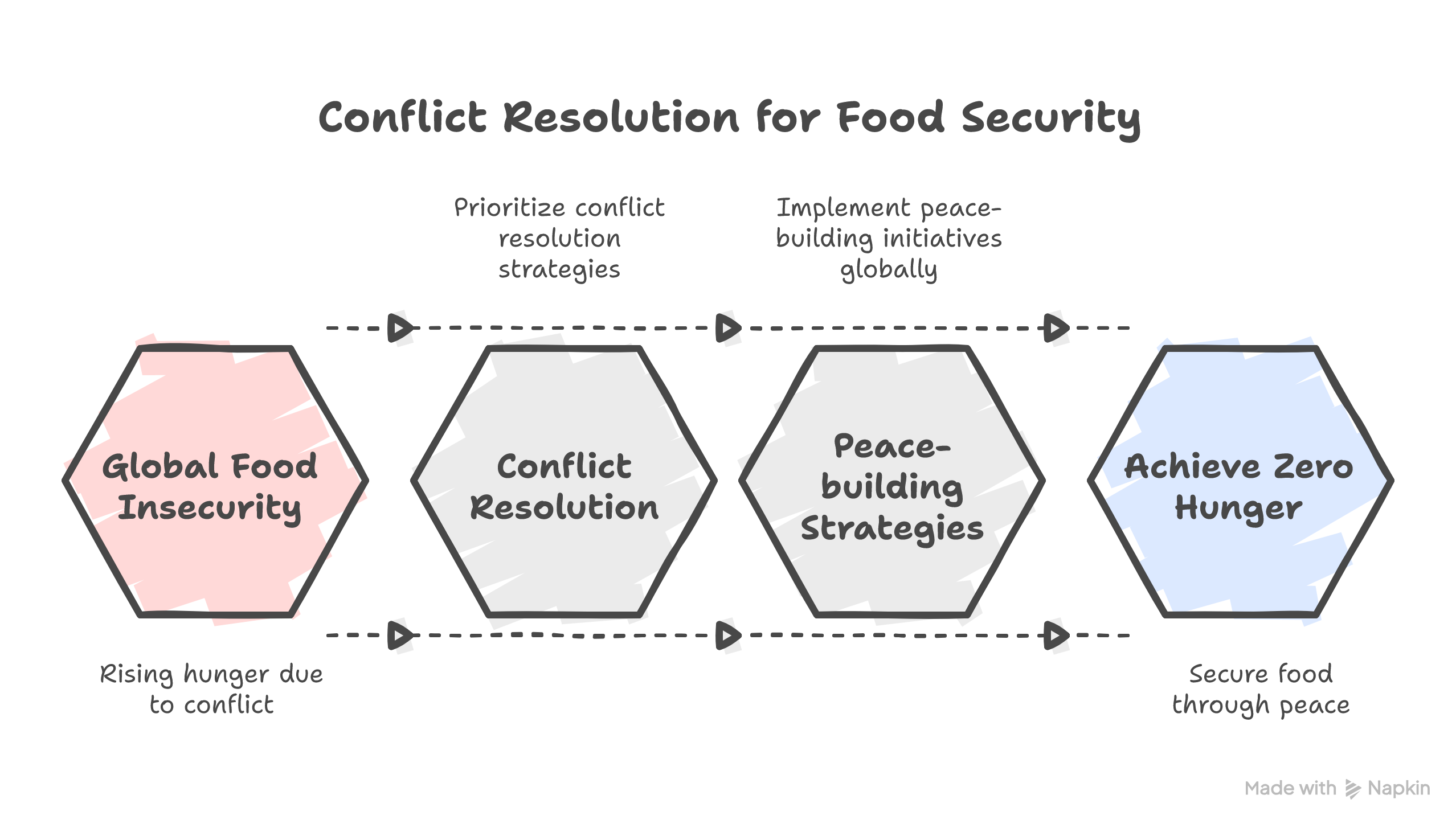
Contribuição: O estudo reforça a importância de integrar estratégias de construção da paz às políticas de segurança alimentar, ressaltando que a eliminação da fome até 2030 depende diretamente da estabilidade geopolítica e da mitigação de conflitos armados.
Referências
Ben Hassen, T., & El Bilali, H. (2022). Impacts of the Russia-Ukraine War on Global Food Security : Towards More Sustainable and Resilient Food Systems? Foods, 11(2301). https://doi.org/10.3390/foods11152301
Bergmann, M., Toygür, I., & Svendsen, O. (2023). A Continent Forged in Crisis Assessing Europe One Year into the War. The Center for Strategic and International Studies (CSIS).
Bizarrias, F. S. (2024). Governance and Sustainability in Developing Countries: Intelectual Structure, Trends and Lessons From Brazil and China. SDGs Studies Review , 5(goals), e0150. https://doi.org/10.37497/sdgs.v5igoals.8
Cucato , J., Bizarrias, F. S., Goulart da Silva, J., & Ferreira, M. C. O. (2022). Personal and Spiritual Life Balance During COVID-19: Segmentation and Its Relations with Materialism, Frugality, Well-Being, and Positive Emotions. SDGs Studies Review , 3(goals), e0417. https://doi.org/10.37497/sdgs.v3igoals.3
Cheo, A. E., & Tapiwa, K. A. (2021). SDG 2 – Zero Hunger : Food Security, Improve Nutrition and Sustainable Agriculture. Emerald Publishing Limited.
Escola de Cultura de Pau. (2022). Alert 2022 ! Report on conflicts, human rights, and peacebuilding. Barcelona: Icaria,.
FAO. (2023). Ukraine : Response program, January–December 2023 Restoring food systems and protecting food security in Ukraine. Rome. https://doi.org/10.4060/cc4655en.
Feindouno, S., & Wagner, L. (2020). Les conflits internes dans le monde : Estimer les risques pour cibler la prévention. Fondation pour les études et recherches sur le développement international (Ferdi).
Fleche, E. (2023). No Matter Who’s Fighting, Hunger Always Wins How Violent Actions Drive Food Insecurity.
Glauben, T., Svanidze, M., Götz, L., Prehn, S., Jaghdani, T. J., Đurić, I., & Kuhn, L. (2022). The War in Ukraine, Agricultural Trade and Risks to Global Food Security. Intereconomics, 57(3), 157‑163. https://doi.org/DOI: 10.1007/s10272-022-1052-7
Lima, A. A., & Ribeiro, T. de L. S. (2023). Evolution of Sustainable Development Goals Research in Social Sciences: A Comprehensive Bibliometric Analysis. SDGs Studies Review , 4(goals), e01562. https://doi.org/10.37497/sdgs.v4igoals.4
Lin, F., Li, X., Jia, N., Feng, F., Huang, H., Huang, J., Fan, S., Ciais, P., & Song, X.-P. (2023). The impact of the Russia-Ukraine conflict on global food security. Global Food Security, 36. https://doi.org/10.1016/j.gfs.2022.100661
Maltitz, G., Haywood, L., Mapako, M., & Brent, A. (2009). Analysis of opportunities for biofuel production in sub-Saharan Africa. Natural Resources and Environment, Council for Scientific and Industrial Research(CSIR), Pretoria, South Africa.
Mearsheimer, J. J. (2022). The Causes and Consequences of the Ukraine War. Horizons, 21.
Mills, C. (2024). Sanctions against Russia. House of Commons Library.
Obermeier, A. M., & Rustad, S. A. (2023). Conflict Trends : A Global Overview, 1946–2022. Peace Research Institute Oslo (PRIO).
OECD. (2022). Economic and Social Impacts and Policy Implications of the War in Ukraine. e: https://www.oecd-ilibrary.org/sites/4181d61b-en/index.html?itemId=/content/publication/41 81d61b-en
Ribeiro , R. P., Espuny, A. L. G., & Hermes , A. B. M. (2023). Method for Feasibility Analysis and Implementation of SDGs in Brazilian Municipalities: The Bah! Method. SDGs Studies Review , 4(goals), e01573. https://doi.org/10.37497/sdgs.v4igoals.7
Russell, M. (2022). Western sanctions and Russia What are they ? Do they work? European Parliamentary Research Service (EPRS).
United Nations. (2019). Zero hunger : Why it matters. New York, NY: United Nations. Retrieved from https:// www.un.org/sustainabledevelopment/wp-content/ uploads/2016/08/2.pdf.
United Nations and World Bank. (2018). Pathways for Peace Inclusive Approaches to Preventing Violent Conflict. Washington, DC: World Bank. doi:10.1596/978-1- 4648-1162-3. License: Creative Commons Attribution CC BY 3.0 IGO.
World Food Programme. (2021). War In Ukraine Drives Global Food Crisis Hungry world at critical crossroads.