

Palavras-chave
Escrita de Ensaios
Escala Multidimensional de Ética (MES)
Análise Configuracional
Análise Qualitativa Comparativa De Conjuntos Fuzzy (FSQCA)
Como Citar


Resumo
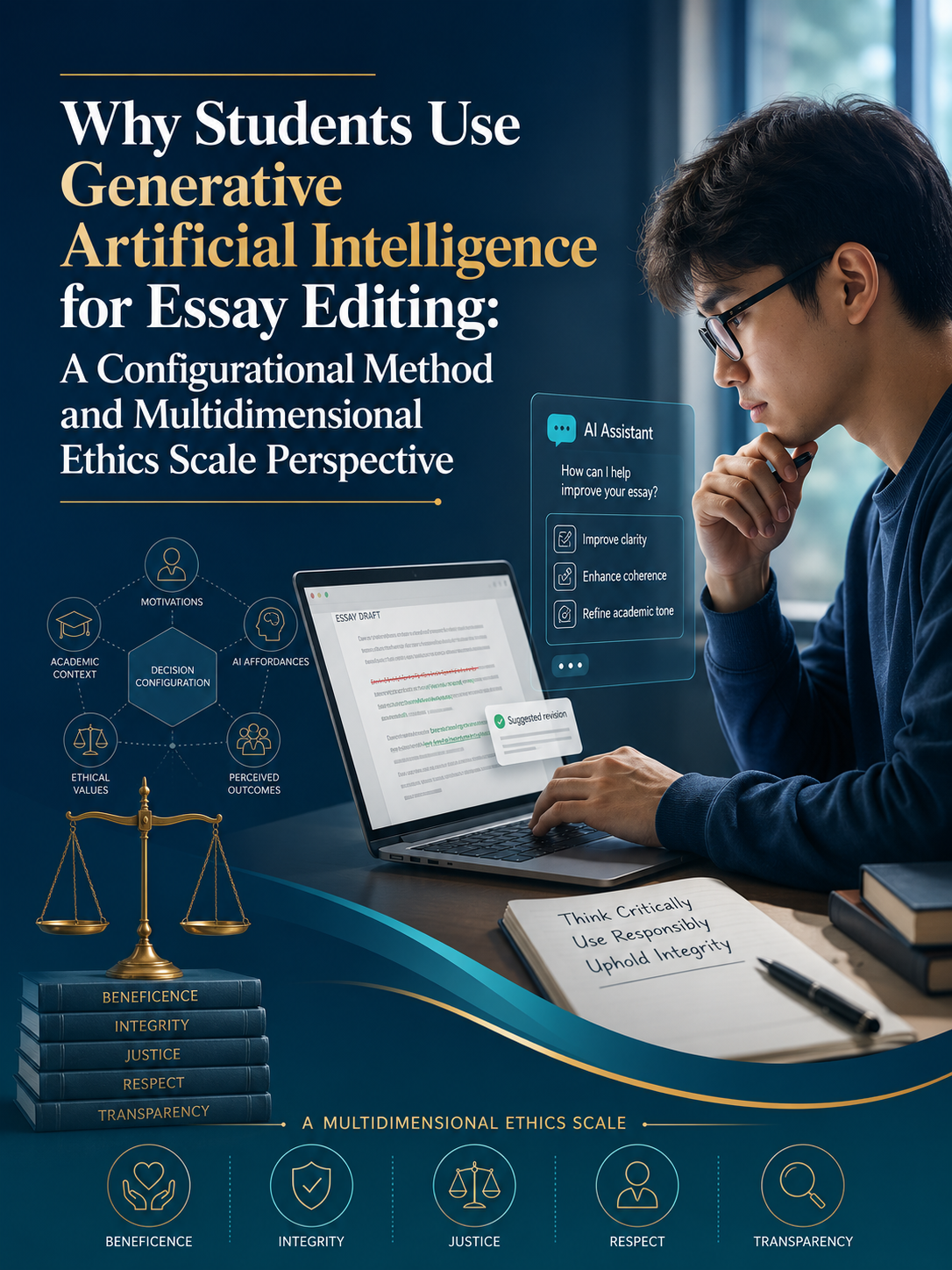
Contexto: A rápida emergência da inteligência artificial generativa (IAG) está a ter um impacto substancial em numerosas áreas do ensino superior, incluindo a escrita académica. A sua utilização como assistente linguístico ocupa uma posição eticamente ambígua entre o apoio académico legítimo e práticas que podem fomentar a dependência tecnológica ou comprometer a integridade académica.
Objetivo: Examinar a utilização da IAG por estudantes universitários num cenário académico específico: a sua utilização como assistente linguístico para melhorar a qualidade da escrita e a clareza de ensaios previamente elaborados pelo estudante, sem alterar substancialmente o seu conteúdo. O objetivo é analisar de que modo diferentes juízos éticos moldam a adoção desta prática pelos estudantes, que ocupa uma posição intermédia entre o apoio académico legítimo e os potenciais riscos de dependência tecnológica ou fraude académica.
Métodos: O estudo baseia-se na Escala Multidimensional de Ética, considerando quatro dimensões morais: justiça, relativismo, consequencialismo e deontologia. Incorpora também variáveis sociodemográficas e académicas, incluindo género, situação laboral e desempenho académico percebido. Metodologicamente, aplica-se a análise qualitativa comparativa de conjuntos fuzzy (fsQCA) para identificar configurações causais associadas tanto à utilização como à não utilização da IAG.
Resultados: A aceitação não depende de uma única dimensão ética, mas de combinações específicas de juízos morais. O consequencialismo emerge como a condição mais relevante nas trajetórias que conduzem à utilização e surge frequentemente combinado com perceções favoráveis de justiça e relativismo. Em contraste, a rejeição apresenta uma estrutura mais fragmentada e uma menor cobertura explicativa, particularmente quando avaliações éticas desfavoráveis, especialmente avaliações consequencialistas, se combinam com fatores sociodemográficos.
Conclusão: A aceitação e a rejeição, por parte dos estudantes, da edição de ensaios apoiada pela IAG seguem lógicas configuracionais assimétricas, mostrando como diferentes juízos éticos se combinam para explicar a utilização de tecnologia académica num contexto moralmente ambíguo. Os resultados destacam a necessidade de regras institucionais claras, formação ética e critérios transparentes para a utilização académica da IAG. As universidades devem distinguir entre apoio linguístico aceitável e práticas que possam comprometer a integridade académica, ajudando simultaneamente os estudantes a desenvolver utilizações responsáveis e reflexivas da IAG.
Referências
Ahadzadeh, A. S., Ong, F. S., Deng, R., & Ali, R. S. (2024). Unravelling the Relationship between Competitiveness Trait and Intention to Use Memory Implants: The Moderating Roles of Moral Equity, Egoism, and Utilitarianism. International Journal of Human–Computer Interaction, 40(24), 8922–8936. https://doi.org/10.1080/10447318.2023.2291621
Alexander, L., & Moore, M. (2024). Deontological ethics. In E. N. Zalta & U. Nodelman (Eds.), The Stanford Encyclopedia of Philosophy (Winter 2024 Edition). Metaphysics Research Lab, Stanford University. https://plato.stanford.edu/archives/win2024/entries/ethics-deontological/
Amin, M. Al, Kim, Y. S., & Noh, M. (2025). Unveiling the drivers of ChatGPT utilization in higher education sectors: the direct role of perceived knowledge and the mediating role of trust in ChatGPT. Education and Information Technologies, 30(6), 7265–7291. https://doi.org/10.1007/s10639-024-13095-y
Andersen, S., & Hjortskov, M. (2019). The unnoticed influence of peers on educational preferences. Behavioural Public Policy, 6(4), 530–553. https://doi.org/10.1017/bpp.2019.1
Andrés-Sánchez, J., Arias-Oliva, M., & Pelegrín-Borondo, J. (2021). The influence of ethical judgements on acceptance and non-acceptance of wearables and insideables: Fuzzy set qualitative comparative analysis. Technology in Society, 67, 101689. https://doi.org/10.1016/j.techsoc.2021.101689
Arli, D., Tjiptono, F., & Porto, R. (2015). The impact of moral equity, relativism and attitude on individuals’ digital piracy behaviour in a developing country. Marketing Intelligence & Planning, 33(3), 348–365. https://doi.org/10.1108/MIP-09-2013-0149
Baghramian, M., & Carter, J. A. (2025). Relativism. In E. N. Zalta & U. Nodelman (Eds.), The Stanford Encyclopedia of Philosophy (Spring 2025 Edition).
Barbosa, J. (2024). Higher education in ethics and deontology: Student’s perspective survey. WSEAS Transactions on Advances in Engineering Education, 21, 128–138.
Basch, C. H., Hillyer, G. C., Gold, B., & Yousaf, H. (2025). Understanding artificial intelligence knowledge and usage among college students: Insights from a survey on classroom, coursework, and personal applications. Review of Artificial Intelligence in Education, 6(i), e037. https://doi.org/10.37497/rev.artif.intell.educ.v6ii.37
Biloš, A., & Budimir, B. (2024). Understanding the Adoption Dynamics of ChatGPT among Generation Z: Insights from a Modified UTAUT2 Model. J. Theor. Appl. Electron. Commer. Res., 19(2), 863–879. https://doi.org/10.3390/jtaer19020045
Birkland, J. L. H. (2019). Understanding the ICT User Typology and the User Types. In Gerontechnology (pp. 95–106). Emerald Publishing Limited. https://doi.org/10.1108/978-1-78743-291-820191009
Camilleri, M. A. (2024). Factors affecting performance expectancy and intentions to use ChatGPT: Using SmartPLS to advance an information technology acceptance framework. Technological Forecasting and Social Change, 201, 123247. https://doi.org/10.1016/j.techfore.2024.123247
Campo, L., Delgado, N., Etxabe-Urbieta, J. M., Kanso, H., & Gueye, M. L. (2025). Relationship Between the Use of ChatGPT and Plagiarism in Higher Education: The Influence of Gender, Age and Previous Academic Results. Innovative Higher Education. https://doi.org/10.1007/s10755-025-09830-z
Cebrián Cifuentes, S., Guerrero Valverde, E., & Checa Caballero, S. (2024). The Vision of University Students from the Educational Field in the Integration of ChatGPT. Digital, 4(3), 648–659. https://doi.org/10.3390/digital4030032
Cheung, G. W., Cooper-Thomas, H. D., Lau, R. S., & Wang, L. C. (2024). Reporting reliability, convergent and discriminant validity with structural equation modeling: A review and best-practice recommendations. Asia Pacific Journal of Management, 41(2), 745–783. https://doi.org/10.1007/s10490-023-09871-y
Dahl, B. M., Vasset, F., & Frilund, M. (2023). Students’ approaches to scientific essay writing as an educational method in higher education: A mixed methods study. Social Sciences & Humanities Open, 7(1), 100389.
Dwivedi, Y. K., Kshetri, N., Hughes, L., Slade, E. L., Jeyaraj, A., Kar, A. K., & Wright, R. (2023). Opinion paper: “So what if ChatGPT wrote it?” Multidisciplinary perspectives on opportunities, challenges and implications of generative conversational AI for research, practice and policy. International Journal of Information Management, 71, 102642. https://doi.org/10.1016/j.ijinfomgt.2023.102642
Fiss, P. C. (2011). Building better causal theories: A fuzzy set approach to typologies in organization research. Academy of Management Journal, 54(2), 393–420. https://doi.org/10.5465/amj.2011.60263120
Gauttier, S. (2019). ‘I’ve got you under my skin’–The role of ethical consideration in the (non-) acceptance of insideables in the workplace. Technology in Society, 56, 93–108. https://doi.org/10.1016/j.techsoc.2018.09.008
Gorrieri, L. (2025). Should I use ChatGPT as an academic aid? A response to Aylsworth and Castro. Philosophy & Technology, 38(1), 8. https://doi.org/10.1007/s13347-024-00831-y
Hair, J. F., Risher, J. J., Sarstedt, M., & Ringle, C. M. (2019). When to use and how to report the results of PLS-SEM. European Business Review, 31(1), 2–24. https://doi.org/10.1108/EBR-11-2018-0203
Kasneci, E., Seßler, K., Küchemann, S., Bannert, M., Dementieva, D., Fischer, F., & Kasneci, G. (2023). ChatGPT for good? On opportunities and challenges of large language models for education. Learning and Individual Differences, 103, 102274. https://doi.org/10.1016/j.lindif.2023.102274
Killen, M. (2018). The origins of morality: Social equality, fairness, and justice. Philosophical Psychology, 31(5), 767–803. https://doi.org/10.1080/09515089.2018.1486612
Leonard, L. N., Riemenschneider, C. K., & Manly, T. S. (2017). Ethical behavioral intention in an academic setting: Models and predictors. Journal of Academic Ethics, 15(2), 141–166. https://doi.org/10.1007/s10805-017-9273-2
Licht, K. de F. (2024). Generative artificial intelligence in higher education: Why the “banning approach” to student use is sometimes morally justified. Philosophy & Technology, 37(3), 113. https://doi.org/10.1007/s13347-024-00799-9
Livian, Y.-F. (2026). The role of generative AI for academic writing: A risk of disappearance of students skills? A reflection in the French context. Review of Artificial Intelligence in Education, 7(i), e059. https://doi.org/10.37497/rev.artif.intell.educ.v7ii.59
Menon, D., & Shilpa, K. (2023). “Chatting with ChatGPT”: Analyzing the factors influencing users’ intention to use the OpenAI’s ChatGPT using the UTAUT model. Heliyon, 9(11), e20142. https://doi.org/10.1016/j.heliyon.2023.e20962
Naznin, K., Al Mahmud, A., Nguyen, M. T., & Chua, C. (2025). ChatGPT Integration in Higher Education for Personalized Learning, Academic Writing, and Coding Tasks: A Systematic Review. Computers, 14(2). https://doi.org/10.3390/computers14020053
Nguyen, N. T., Basuray, M. T., Smith, W. P., Kopka, D., & McCulloh, D. (2008). Moral issues and gender differences in ethical judgment using Reidenbach and Robin’s (1990) multidimensional ethics scale: Implications in teaching of business ethics. Journal of Business Ethics, 77, 417–430. https://doi.org/10.1007/s10551-007-9357-9
Pappas, I. O., & Woodside, A. G. (2021). Fuzzy-set Qualitative Comparative Analysis (fsQCA): Guidelines for research practice in Information Systems and marketing. International Journal of Information Management, 58. https://doi.org/10.1016/j.ijinfomgt.2021.102310
Pelegrín-Borondo, J. P., Pascual, C. O., Pascual, L. B., & Milon, A. G. (2024). Impact of ethical judgment on university professors encouraging students to use AI in academic tasks. In The leading role of smart ethics in the digital world (pp. 53–61). Universidad de La Rioja.
Pérez-Portabella, A., Arias-Oliva, M., Padilla-Castillo, G., & de Andrés-Sánchez, J. (2025). Passing with ChatGPT? Ethical Evaluations of Generative AI Use in Higher Education. Digital, 5(3). https://doi.org/10.3390/digital5030033
Pérez-Portabella, A., Arias-Oliva, M., Padilla-Castillo, G., & de Andrés-Sánchez, J. (2026). Ethical conditions for university students’ adoption of large language models in exam preparation contexts. Computers and Education Open, 10, 100323. https://doi.org/10.1016/j.caeo.2025.100323
Pérez-Portabella, A., de Andrés-Sánchez, J., Arias-Oliva, M., & Padilla-Castillo, G. (2026). Ethical Judgments and Weakness of Will in the Misuse of Generative AI: The Case of Academic Essay Production among Higher Education Students. Innovative Higher Education, 51(2), 453–479. https://doi.org/10.1007/s10755-026-09885-6
Pérez-Portabella, A., de Andrés-Sánchez, J., Arias-Oliva, M., & Souto-Romero, M. (2026). Explaining higher education social sciences students’ misuse of generative artificial intelligence: evidence from a multidimensional ethics scale. SN Social Sciences, 6(1), 18. https://doi.org/10.1007/s43545-025-01294-4
Pilcher, J. J., & Smith, P. D. (2024). Social context during moral decision-making impacts males more than females. Frontiers in Psychology, 15, 1397069. https://doi.org/10.3389/fpsyg.2024.1397069
Prashar, P., Gupta, Y., & Dwivedi, Y. K. (2023). Plagiarism awareness efforts, students’ ethical judgment and behaviors: A longitudinal experiment study on ethical nuances of plagiarism in higher education. Studies in Higher Education, 49(6), 929–955. https://doi.org/10.1080/03075079.2023.2253835
Ragin, C. C. (2018). User’s Guide to Fuzzy-Set/Qualitative Comparative Analysis 3.0. https://sites.socsci.uci.edu/~cragin/fsQCA/software.shtml
Ramberg, J., & Modin, B. (2019). School effectiveness and student cheating: Do students’ grades and moral standards matter for this relationship? Social Psychology of Education, 22, 1313–1337. https://doi.org/10.1007/s11218-019-09486-6
Reidenbach, R. E., & Robin, D. P. (1990). Toward the development of a multidimensional scale for improving evaluations of business ethics. Journal of Business Ethics, 9(8), 639–653. https://doi.org/10.1007/BF00383391
Rua, T., Lawter, L., & Andreassi, J. (2024). The ethical student scale: development of a new measure. Organization Management Journal, 21(3), 117–128. https://doi.org/10.1108/OMJ-03-2023-1831
Rutten, R., & Rubinson, C. (2022). A vocabulary for QCA.
Shawver, T. J., & Sennetti, J. T. (2009). Measuring ethical sensitivity and evaluation. Journal of Business Ethics, 88(4), 663–678. https://doi.org/10.1007/s10551-008-9973-z
Silva, A. de O., & Janes, D. (2025). Editorial perspective on the 2025 edition (V6) of the Review of Artificial Intelligence in Education: Advances, challenges, and theoretical convergences in global AI-in-education research. Review of Artificial Intelligence in Education, 6(i), e065. https://doi.org/10.37497/rev.artif.intell.educ.v6ii.65
Sinnott-Armstrong, W. (2023). Consequentialism. In E. N. Zalta (Ed.), The Stanford Encyclopedia of Philosophy.
Strzelecki, A. (2024). To use or not to use ChatGPT in higher education? A study of students’ acceptance and use of technology. Interactive Learning Environments, 32(9), 5142–5155. https://doi.org/10.1080/10494820.2023.2209881
Tsaousis, I., & Alghamdi, M. H. (2022). Examining academic performance across gender differently: Measurement invariance and latent mean differences using bias-corrected bootstrap confidence intervals. Frontiers in Psychology, Volume 13-2022. https://doi.org/10.3389/fpsyg.2022.896638
Venkatesh, V., Morris, M. G., Davis, G. B., & Davis, F. D. (2003). User Acceptance of Information Technology: Toward a Unified View. MIS Quarterly, 27(3), 425–478. https://doi.org/10.2307/30036540
Woodside, A. G. (2014). Embrace perform model: Complexity theory, contrarian case analysis, and multiple realities. Journal of Business Research, 67(12), 2495–2503. https://doi.org/10.1016/j.jbusres.2014.07.006
Yang, S. C. (2012). Ethical academic judgments and behaviors: Applying a multidimensional ethics scale to measure the ethical academic behavior of graduate students. Ethics & Behavior, 22(4), 281–296. https://doi.org/10.1080/10508422.2012.672907
Yudhistyra, W. I., & Srinuan, C. (2024). Exploring the Acceptance of Technological Innovation Among Employees in the Mining Industry: A Study on Generative Artificial Intelligence. IEEE Access, 12, 165797–165809. https://doi.org/10.1109/ACCESS.2024.3493242